Do the Driving Modes in Cadillac Lyriq Offer Different Ranges or Battery Usages?

Electric vehicles promise quiet performance, lower running costs, and a different relationship with energy than gas-powered cars. But for many drivers, one big question always comes up: how far will it really go on a charge?
If you’re looking at the Cadillac Lyriq, you may also be wondering whether its driving modes actually change range or battery usage in a meaningful way — or if they’re mostly about feel and performance.
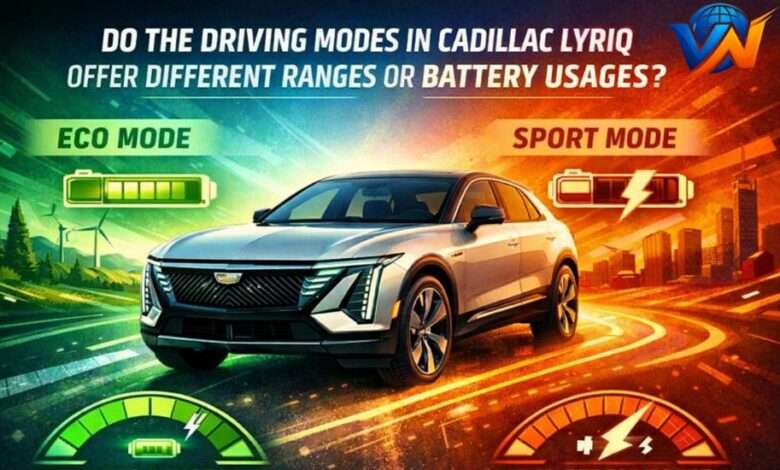
The short answer is yes: driving modes do influence how efficiently the Lyriq uses its battery, but not in the simplistic “good mode vs bad mode” way some people expect. The differences are subtle, situational, and tied closely to how power is delivered, recovered, and managed.
Let’s break it all down clearly and calmly, without hype or guesswork.
Cadillac Lyriq Driving Modes – Quick Facts
| Feature | Details |
|---|---|
| Vehicle Type | All-electric luxury SUV |
| Battery System | High-capacity lithium-ion battery pack |
| Primary Driving Modes | Tour, Sport, Snow/Ice, Custom (availability varies by trim) |
| Default Mode | Tour Mode |
| Efficiency-Focused Mode | Tour Mode |
| Performance-Focused Mode | Sport Mode |
| Traction-Focused Mode | Snow/Ice Mode |
| Customization Option | Yes, selected driving characteristics can be personalized |
| Regenerative Braking | Adjustable, impacts energy recovery |
| Battery Capacity Change by Mode | No |
| Energy Usage Difference by Mode | Yes, based on throttle response, regen, and system behavior |
| Best Mode for Consistent Range | Tour Mode |
| Biggest Factor in Real-World Range | Driving style and road conditions |
How Driving Modes Work in the Cadillac Lyriq
Driving modes in an electric vehicle are not cosmetic settings. They are software-controlled profiles that adjust how different vehicle systems behave together.
In the Lyriq, these modes influence several core areas at the same time:
- Throttle sensitivity
- Power delivery timing
- Regenerative braking strength
- Traction and stability controls
- Steering and ride behavior
- In some cases, energy management priorities
What does not change is the physical battery capacity. The battery doesn’t get bigger or smaller depending on the mode. What changes is how quickly energy is used and how much of it is recovered during everyday driving.
A helpful comparison is thinking about a smartphone. The battery is the same size whether you’re gaming, streaming video, or just texting — but how long it lasts depends entirely on what the software is asking the hardware to do.
Driving modes work the same way.
Tour Mode and Everyday Efficiency
Why Tour Mode Is the Baseline
Tour Mode is generally considered the Lyriq’s default or everyday driving setting. It’s designed to balance comfort, smoothness, and efficiency without drawing attention to itself.
From an energy perspective, Tour Mode usually offers:
- Gradual throttle response
- Predictable power delivery
- Moderate regenerative braking
- Balanced climate and system behavior
Because of this balance, Tour Mode tends to deliver the most consistent real-world range for most drivers in normal conditions.
How Tour Mode Supports Better Range
When throttle response is smoother, drivers naturally apply less sudden power. That reduces energy spikes, which are one of the biggest contributors to range loss in electric vehicles.
Tour Mode also tends to favor regenerative braking during deceleration. That means when you slow down — especially in city traffic — some of the energy that would normally be lost as heat is sent back into the battery.
For drivers who:
- Commute daily
- Drive mixed city and highway routes
- Prefer a relaxed driving feel
Tour Mode often becomes the most efficient option without any conscious effort.
Real-World Expectations
In practical terms, Tour Mode usually aligns closest to the vehicle’s advertised range estimates. It’s not necessarily the “maximum possible” range mode, but it’s the most reliable and repeatable one.
That reliability is why many reviews and owner discussions treat Tour Mode as the reference point when comparing other modes.
Do the Driving Modes in Cadillac Lyriq Offer Different Ranges or Battery Usages?
What Changes in Sport Mode
Sport Mode exists for drivers who want sharper response and a more engaging driving experience. When activated, the vehicle’s software prioritizes performance over efficiency.
Key changes typically include:
- More aggressive throttle mapping
- Faster power delivery
- Reduced regenerative braking feel
- Tighter steering response
All of these adjustments make the vehicle feel quicker and more responsive, but they also increase energy demand.
Why Sport Mode Uses More Battery
Electric motors deliver instant torque, and Sport Mode encourages the driver to access that torque more frequently and more quickly.
Every strong acceleration pulls a higher amount of power from the battery in a short time. While the vehicle can handle it easily, energy efficiency drops when power is delivered aggressively.
Reduced regenerative braking also plays a role. When regen is weaker, less energy is recovered during slowing or coasting, which means more total energy is consumed over a trip.
How Much Range Difference Is Typical?
In normal driving conditions, Sport Mode can reduce effective range by a noticeable but not extreme amount. Many drivers experience:
- Slightly higher energy consumption per mile
- Faster battery drain during frequent acceleration
- Lower total range on longer trips
The difference isn’t dramatic for short drives, but over longer distances, it adds up.
A useful analogy is driving the same route in a gas vehicle using gentle acceleration versus frequent hard launches. You reach the destination either way, but the fuel gauge tells a different story.
Snow, Ice, and Traction-Focused Modes
Purpose Comes First
Snow and ice driving modes are not designed to maximize range. Their primary goal is safety and control when road conditions are poor.
In these modes, the vehicle typically adjusts:
- Torque delivery to reduce wheel spin
- Throttle sensitivity for smoother starts
- Stability and traction control thresholds
These adjustments help maintain grip but can affect energy efficiency.
Why Efficiency Drops Slightly
Limiting wheel spin sounds efficient, and in some cases it is. However, traction-focused systems often involve additional electronic intervention, torque balancing, and conservative power management.
These systems may:
- Use more energy to stabilize the vehicle
- Reduce opportunities for regenerative braking
- Favor control over smooth coasting
As a result, battery usage can increase slightly compared to Tour Mode, especially in stop-and-go winter conditions.
Context Matters
It’s important to note that in slippery conditions, chasing maximum range isn’t realistic or responsible. A modest range reduction is a fair trade-off for improved stability and predictability.
In other words, Snow or Ice Mode isn’t “inefficient” — it’s doing a different job.
Custom Settings, Regenerative Braking, and Driving Style
Custom Modes and Their Impact
Many Lyriq configurations allow drivers to customize certain elements, blending comfort, steering, and responsiveness.
Custom modes don’t automatically improve or reduce range. Their impact depends entirely on how they’re set up.
For example:
- A custom mode with gentle throttle and strong regen may rival Tour Mode efficiency
- A custom mode with aggressive throttle and light regen may behave closer to Sport Mode
The battery doesn’t know the mode’s name — it responds to what the systems are doing.
Regenerative Braking: The Quiet Influencer
Regenerative braking deserves special attention because it plays a huge role in real-world efficiency.
Stronger regen means:
- More energy recovered during slowing
- Less reliance on friction brakes
- Better efficiency in urban traffic
Weaker regen means:
- More coasting
- Less energy recovery
- Higher total consumption over time
Drivers who adapt to regen-friendly habits often see better range regardless of mode.
Driving Style Often Matters More Than Mode
One of the most consistent findings across electric vehicles is that driver behavior can outweigh mode selection.
Two drivers using the same mode can see very different results based on:
- Acceleration habits
- Speed consistency
- Anticipating stops instead of braking late
- Climate control usage
In other words, driving modes shape the vehicle’s personality, but the driver still writes most of the story.
This perspective is worth highlighting, especially for readers of Vista News who want practical takeaways rather than technical noise.
Final Thoughts on Range and Battery Usage
So, do the driving modes in cadillac lyriq offer different ranges or battery usages?
Yes — but not because the battery itself changes.
The differences come from how energy is requested, delivered, and recovered. Tour Mode tends to support the most consistent efficiency. Sport Mode trades some range for responsiveness. Traction-focused modes prioritize control over conservation. Custom settings can fall anywhere in between.
What matters most is matching the mode to the situation and driving with awareness. When drivers understand what each mode is designed to do, they can make informed choices without stress or unrealistic expectations.
In the end, driving modes are tools. Used thoughtfully, they help the Lyriq feel adaptable, capable, and predictable — not confusing or inefficient.
Frequently Asked Questions
1. Do different driving modes in the Cadillac Lyriq change the battery size?
No. The battery’s physical capacity stays the same in every driving mode. What changes is how the vehicle uses that stored energy. Driving modes adjust power delivery, regenerative braking, and system behavior, which affects how quickly the battery is used.
2. Which driving mode offers the best range in normal conditions?
Tour Mode usually delivers the most consistent real-world range for everyday driving. It balances throttle response and regenerative braking in a way that supports efficiency without requiring special driving techniques.
3. Why does Sport Mode reduce range compared to other modes?
Sport Mode allows quicker and more aggressive power delivery. Faster acceleration and reduced energy recovery during slowing both increase battery usage, which can lower total range over longer drives.
4. Does Snow or Ice Mode use more battery?
Snow and Ice modes may use slightly more energy because they prioritize traction and stability over efficiency. These modes adjust torque delivery and control systems to improve safety on slippery roads, which can reduce overall range.
5. Can driving style affect range more than the selected mode?
Yes. Driving habits often have a bigger impact than the mode itself. Smooth acceleration, steady speeds, and effective use of regenerative braking can improve range in any mode, while aggressive driving can reduce it even in efficiency-focused settings.